
Verification starts with a concrete promise: a property is checked against the graph, parameters, shapes, and scalar interpretation that the verifier actually saw. TorchLean’s examples make those objects explicit. Some examples run bound propagation natively over a TorchLean graph. Others replay an exported certificate. In both cases, the important trail is the artifact being checked and the predicate Lean recomputes.
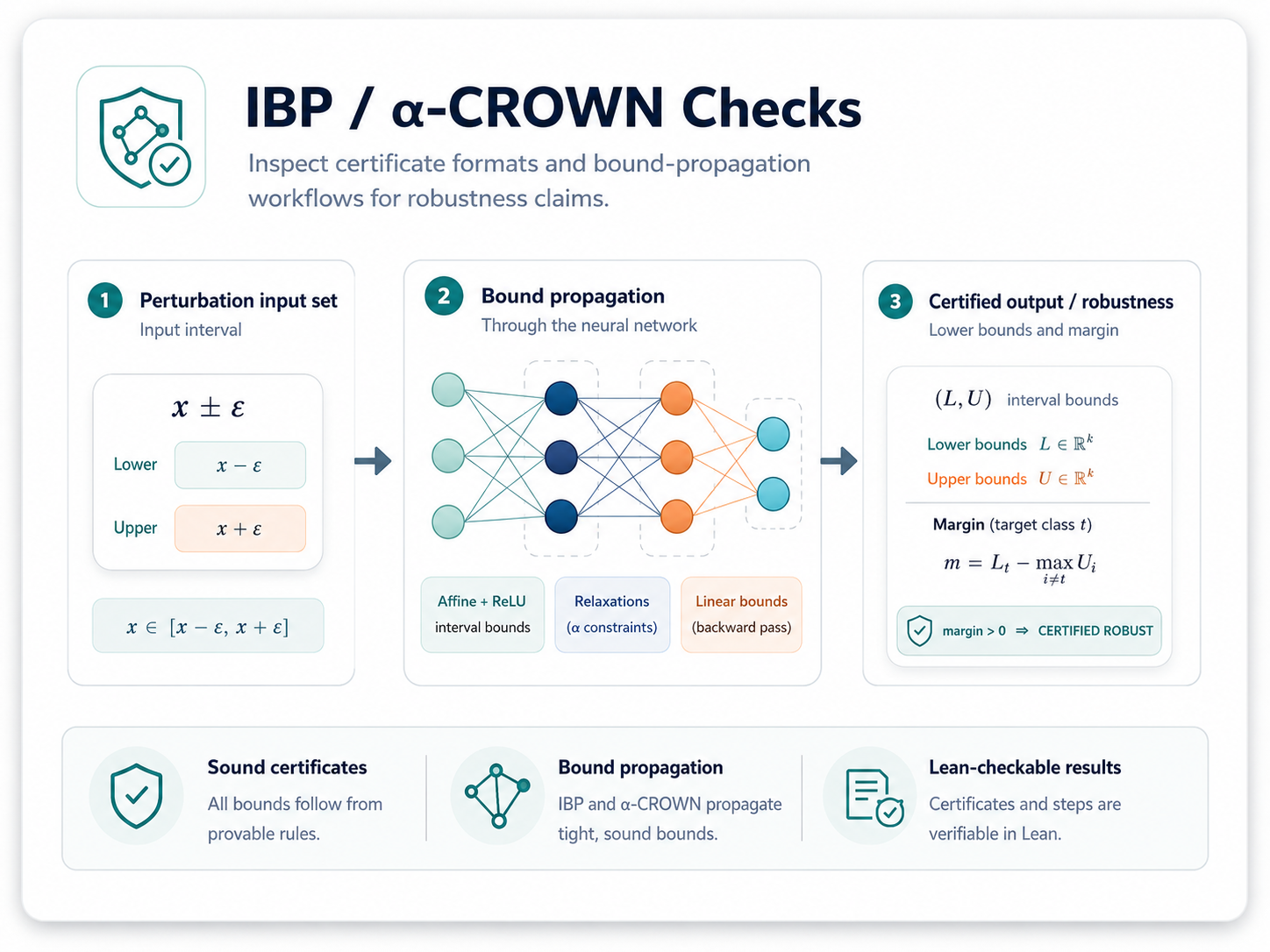
The Question
Most neural-network verification examples begin with a robustness question:
For every input inside a small box around the example point, can the model’s output still satisfy the desired margin or safety condition?
TorchLean represents that question with four concrete objects:
- a model, written in the same API used for training examples;
- a lowered
NN.IR.Graph, so verifier code can traverse named nodes; - an input box, with lower and upper bounds for every input coordinate;
- an output property, usually a margin such as $\operatorname{logit}_{\mathrm{true}}-\operatorname{logit}_{\mathrm{other}}\geq 0$.
The common path is therefore:
- write or import a TorchLean model,
- lower it to
NN.IR.Graph, - attach an input box,
- run a bound engine,
- inspect or check the output bounds.
The reusable workflows under NN/Verification/Builtin/ keep the model, input box, output
property, and bound pass together. The same path works for generated graphs, imported weights, and
external verifier leaves.
The seed box is built explicitly. For the small MLP example, inputCenter is the center point,
eps is the radius, and inputBox is the flattened input box inserted at the lowered input node:
let inputCenter : Tensor α [2] :=
  Tensor.map cast ([0.5, 0.8] : Tensor Float [2])
let eps : α := Runtime.ofFloat 0.1
let inputBox : FlatBox α := NN.Verification.Builtin.lInfBall (α := α) inputCenter eps
let ps : ParamStore α := lowered.seedInputBox inputBox
The pass propagates the input box $[\mathtt{inputCenter}-\mathtt{eps},\mathtt{inputCenter}+\mathtt{eps}]$.
let ibp := lowered.runIBP ps
let outB ← lowered.outputBoxOrThrow ibp
The bound engine returns node-indexed FlatBox values. Each box stores a flattened dimension plus
lower and upper tensors. A sound output enclosure satisfying
$\mathrm{lo}[\mathrm{label}]>\max_{\mathrm{other}}\mathrm{hi}[\mathrm{other}]$ establishes that label
for every input in the seed box. The rounded CLI passes below calculate candidate enclosures.
Applying this argument to them requires a soundness theorem covering the graph, parameters, and
arithmetic; the printed bounds alone do not supply that proof.
IBP: Propagate Boxes Through The Graph
Interval bound propagation assigns a lower and upper bound to each node. A sound transformer for an operation must enclose all possible outputs of that operation when its inputs range over their current boxes.
A scalar example captures the idea. Suppose
\[x \in [-1,2], \qquad y=3x+0.5.\]IBP computes
\[y \in [3(-1)+0.5,\;3(2)+0.5]=[-2.5,6.5].\]For a ReLU node, the transformer is monotone:
\[z \in [\ell,u] \quad\Longrightarrow\quad \operatorname{ReLU}(z) \in [\max(0,\ell),\max(0,u)].\]For a linear layer, the implementation bounds each coefficient-times-input product at both endpoints and accumulates lower and upper sums with directed rounding. With a sound transfer, every true activation is inside the box, but the box may include values that cannot occur together.
That tradeoff explains both why IBP works well as a first verifier and why it can fail to certify true properties. It is fast, local, and easy to compose over graphs; it loses correlations between coordinates.
A Margin Example
Consider a two-logit classifier. To certify class $0$ against class $1$, we want:
\[\operatorname{logit}_0-\operatorname{logit}_1 \geq 0.\]If IBP gives
\[\operatorname{logit}_0 \in [1.2,1.8], \qquad \operatorname{logit}_1 \in [0.1,0.7],\]then the margin is at least $1.2-0.7=0.5$, so the box certifies the property. If instead IBP gives
\[\operatorname{logit}_0 \in [0.8,1.4], \qquad \operatorname{logit}_1 \in [0.2,1.0],\]then the lower margin bound is $0.8-1.0=-0.2$. The property is undecided at the IBP-box level. The model may still be safe; this abstraction was not tight enough for this input box.
CROWN-Style Affine Bounds
CROWN-style passes keep affine upper and lower forms instead of only interval boxes. In other words, the bound can say more than “this node lies between two numbers.” It can be “this node is bounded by a linear expression over the input variables.” That preserves more correlation information.
CROWN still uses IBP intervals, because nonlinear relaxations need pre-activation ranges. Forward CROWN stores affine lower and upper forms for nodes with respect to the chosen input node. Backward CROWN starts from one scalar objective, such as $\operatorname{logit}_0-\operatorname{logit}_1$, and propagates that objective back to an input-box bound.
For ReLU, the affine relaxation depends on the pre-activation interval:
- if the interval is entirely nonnegative, ReLU is exactly the identity;
- if the interval is entirely nonpositive, ReLU is exactly zero;
- if the interval crosses zero, CROWN uses a sound linear envelope.
The built-in workflow asks the lowered graph for forward CROWN bounds after IBP; the public
NN.API.Verification.Lowering module wraps the same call as runCROWN:
let crown ← match lowered.outputBoxCROWN? ps inputBox with
  | .ok outC => pure outC
  | .error msg => throw <| IO.userError msg
The result is another FlatBox for the output node, this time derived from affine lower and upper
forms rather than from interval arithmetic alone.
For a margin objective, the backward pass asks for a bound on one scalar expression, such as $\operatorname{logit}_0-\operatorname{logit}_1$. Instead of bounding every output independently, this lets the verifier push a single objective backward through the graph:
let objV : Tensor α [softmaxOutDim] :=
  Tensor.map cast ([1.0, -1.0, 0.0] : Tensor Float [3])
let obj : FlatTensor α := { n := softmaxOutDim, v := objV }

let margin ← match lowered.backwardObjectiveBox? ps ibp inputBox obj with
  | .ok outC => pure (getAtOrZero outC.lo [0])
  | .error msg => throw <| IO.userError msg
margin is the reported candidate lower bound on $p_0 - p_1$ over the input box. Its semantic
guarantee has the same soundness obligations as the output enclosure above.
backwardObjectiveBox? is runCROWNBackwardObjective applied to the lowered graph’s affine
context, so the caller does not rebuild that context by hand.
The model, graph, bounds, and certificate checks all refer to the same node ids and tensor shapes.
What Each Command Shows
Run the small TorchLean-native examples first:
lake exe verify -- torchlean-ibp
lake exe verify -- torchlean-transformer-ibp --with-crown
lake exe verify -- torchlean-crown-ops
lake exe verify -- torchlean-mlp-workflow
lake exe verify -- digits-train-certify --epochs=50 --eps=0.02 --max=100
lake exe verify -- margin-report
lake exe verify -- camera-box3d-cert
torchlean-ibp is the smallest graph-bound check: lower a TorchLean model, attach an input
box, and propagate interval bounds to the output. torchlean-transformer-ibp runs the same
workflow over an attention block and an encoder block; --with-crown adds the affine pass.
torchlean-crown-ops uses the same graph style but adds forward and backward CROWN-style affine
passes over softmax and MSE-loss operations. torchlean-mlp-workflow trains a classifier and then
checks robustness with the alpha-beta-CROWN path on the resulting graph. The arithmetic used by
these commands follows the same --arithmetic native|ieee flag as the examples.
The remaining commands show artifact boundaries. digits-train-certify trains a small
sklearn-digits classifier with Python, exports weights and test examples, then immediately
loads them and runs bound and margin checks in Lean. margin-report checks the internal arithmetic
of an exported logit-bound report; it does not establish the provenance of those bounds.
vnncomp-mnistfc exercises a compact
VNN-COMP-style fully connected MNIST network/property pair. camera-box3d-cert checks a camera
projection certificate for a 3D box artifact by recomputing the projected corners and the claimed
2D envelope.
The MNIST runner labels its result numerically_refuted, not safe. It uses outward-widened host
Float operations to refute the unsafe output region, but that executable result is not itself a
Lean theorem about real-valued network semantics.
The MNIST workflow requires externally prepared weights and suite files, which are not bundled. After preparing the JSON artifacts described in the VNN-COMP artifact README, run:
lake exe verify -- vnncomp-mnistfc \
  --weights=_external/vnncomp/mnist_fc/model_weights.json \
  --suite=_external/vnncomp/mnist_fc/suite.json
Typical output from the native CROWN example includes softmax bounds, an MSE-loss bound, a margin lower bound, and the backward objective bound. The exact numbers depend on dtype and runtime flags, but the shape of the output should look like this:
[IBP] logits lo = ...
[IBP] logits hi = ...
[CROWN] logits lo = ...
[CROWN] logits hi = ...
[CROWN-backward] objective bound = ...
Then check the bundled alpha-beta-CROWN-style leaf artifact:
lake exe verify -- abcrown-leaf
Run the compact LiRPA-style JSON fixtures:
lake exe verify -- lirpa-mlp
lake exe verify -- lirpa-cnn
lake exe verify -- lirpa-attention
lake exe verify -- lirpa-gru
lake exe verify -- lirpa-encoder
These commands are good checks when changing certificate parsing or bound-replay utilities. Each bundled fixture names a small supported fragment, such as an MLP, convolutional head, attention softmax block, GRU gate, or transformer encoder block. Lean checks the artifact it receives; the fixture is evidence for the checker format and replay predicate, not a claim about every possible LiRPA producer.
To run the fast non-interactive checker suite:
lake exe verify -- all
External Artifacts
The alpha-beta-CROWN leaf checker is a structural checker for a declared leaf artifact. Vanilla
alpha-beta-CROWN does not emit TorchLean’s JSON schema directly. The current path is: an external
verifier exposes or dumps terminal leaf data, TorchLean’s exporter converts that data to
abcrown_leaf_artifact_v0_1, and Lean checks the represented part of the artifact: box nesting,
compatible tensor dimensions, and the witness lower-bound test.
That last sentence is the trust boundary. The Lean checker accepts a specific schema and checks the part of the terminal leaf represented in that schema. If the exporter lies about what the external verifier produced, that is an exporter/provenance boundary. If the JSON satisfies the schema and witness predicate, the Lean side check is local and reproducible.
The witness selects one output coordinate. The checker requires its lower bound to exceed the
corresponding unsafe threshold. Mismatched dimensions and out-of-range witness indices are rejected.
The implementation lives in NN.Verification.Cert.AbCrownLeafCert and its shared verification
utilities.
The CLI entry point defaults to a small bundled artifact:
lake exe verify -- abcrown-leaf \
  NN/Examples/Verification/AbCrown/sample_abcrown_leaf_artifact_v0_1.json
To create that schema from a raw terminal-domain dump, use the TorchLean exporter:
python3 scripts/verification/abcrown/export_leaf_artifact.py \
  --input NN/Examples/Verification/AbCrown/example_raw_leaf_dump.json \
  --out _external/abcrown/leaf_artifact.json \
  --check
ABCROWN_ARTIFACT_OUT is the TorchLean side exporter hook. Use it from a small wrapper or
instrumented external verifier to write the schema that Lean checks. The external search still owns
the branch-and-bound run; TorchLean owns the exported artifact schema and the local witness
predicate replayed by the checker.
Verification Results
The native and external examples produce different kinds of evidence:
- IBP and CROWN commands lower a TorchLean model, attach an input box, propagate bounds over the supported graph operations, and report the resulting margin predicate.
- Margin certificates are replayable JSON claims: the file names a graph-shaped predicate and Lean recomputes the margin condition.
- LiRPA-style fixtures exercise small exported bound artifacts for supported network fragments. They are regression fixtures for the checker API and examples of the finite objects Lean can reload.
- $\alpha,\beta$-CROWN-style leaf artifacts carry one terminal external-verifier claim into Lean. The checker validates the schema, box nesting, tensor dimensions, and witness lower-bound comparison represented in that artifact.
- VNN-COMP-style examples show how a benchmark-shaped network/property pair can enter TorchLean while the benchmark runner remains an external producer.
- PINN, ODE, spline, and geometry examples use the same pattern outside image classification: a producer exports an artifact, and Lean recomputes the residual, enclosure, interval, or projection predicate being checked.
When a command succeeds, cite the object and predicate it checked. For example, say that Lean
accepted the abcrown_leaf_artifact_v0_1 witness predicate for a particular JSON file, or that the
TorchLean graph IBP pass reported a margin computed for the stated input box and arithmetic. That
phrasing is more precise than saying only that a verifier ran.
A green command should always be read together with the object it checked. The question is: which graph, which box, which scalar semantics, which certificate schema, and which theorem or checker predicate did this command use?
Where To Read The Source
- TorchLean-native graph and IBP entry point:
NN/Verification/Builtin/IBPWorkflow.lean - CROWN operation entry point:
NN/Verification/Builtin/CrownOpsWorkflow.lean - $\alpha,\beta$-CROWN-style leaf artifact checker:
NN.Verification.Cert.AbCrownLeafCert - VNN-COMP-style MNIST entry point:
NN.Verification.VNNComp.MnistFC - 3D geometry certificate checker:
NN.Verification.Geometry3D - Verification guide chapter: Neural Network Verification
The examples provide commands that check the relevant graph, bound, or certificate artifact in Lean, rather than relying only on plots or external Python objects.