
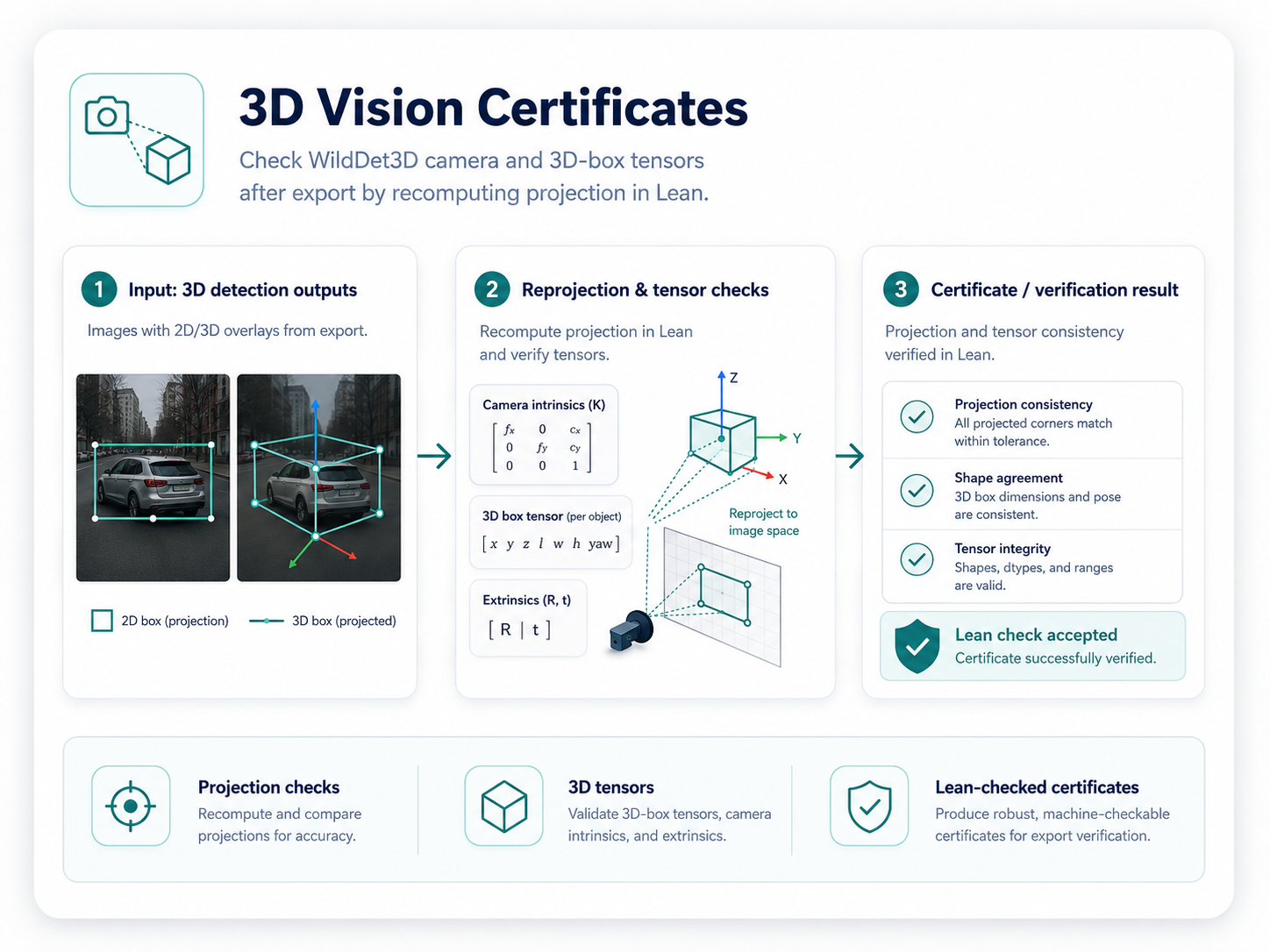
A 3D detector can act as an artifact producer. The detector/exporter emits a camera matrix, eight 3D box corners, image dimensions, and a claimed 2D box. TorchLean reloads that JSON, recomputes the projection in Lean, and checks whether the claimed box really encloses the projected corners.
The result is a small certificate for this exported scene: the checker establishes that the claimed 2D box follows from the camera and corner tensors in the artifact. The detector remains the producer; TorchLean checks the geometric claim it exported.
Checked Geometry
The checked claim is geometric:
camera_Pis a $3 \times 4$ projection matrix;corners3dis an $8 \times 3$ matrix of cuboid corners;bbox2dstores $[x_{\min}, y_{\min}, x_{\max}, y_{\max}]$.
For each corner $(x,y,z)$, the checker forms the homogeneous point $[x,y,z,1]$, multiplies by the $3 \times 4$ camera matrix, divides image coordinates by projected depth, and compares the resulting pixel $(u,v)$ with both the image bounds and the claimed 2D box. The depth check matters: a point behind the camera is rejected before its divided coordinates can be treated as an image point.
Lean checks that image dimensions are positive, the box is ordered and inside the image, all eight corners have positive projected depth, every projected corner is inside the image, and every projected corner is enclosed by the claimed 2D box.
The core artifact type is a tensor-shaped camera certificate:
structure BoxCameraCert (α : Type) where
  width : α
  height : α
  tol : α
  camera : CameraP α
  corners : BoxCorners α
  bbox : Box2D α
The executable checker is a Boolean function:
def checkCert (cert : BoxCameraCert α) : Bool :=
  checkPositiveImageSize cert &&
    checkBBoxOrdered cert &&
    checkBBoxInsideImage cert &&
    checkPositiveDepths cert &&
    checkProjectedInImage cert &&
    checkBBoxEnclosesProjection cert
And the theorem connects the executable checker to the formal contract. The excerpt omits the standard arithmetic/typeclass parameters; the full theorem is in the 3D geometry verification source:
theorem checkCert_sound
    {cert : BoxCameraCert α} (h : checkCert cert = true) :
    Verified3DBox cert
The key pattern is simple: the detector and exporter produce data; the Lean checker recomputes the geometric claim from that data.
Run The Real Model Path
The direct 3D detector route uses WildDet3D from Hugging Face. The optional path installs a real 3D detector pipeline, so it is better as an end-to-end example than as a first runtime check.
python3 -m pip install -r scripts/verification/geometry3d/requirements-wilddet3d.txt
python3 -m pip install --no-deps utils3d
python3 scripts/verification/geometry3d/export_wilddet3d_box3d_cert.py \
  --text-prompt cat \
  --out _external/geometry3d/wilddet3d/wilddet3d_cat_box3d_cert.json \
  --verify --overlay
The command exports and checks:
lake exe verify -- camera-box3d-cert \
  _external/geometry3d/wilddet3d/wilddet3d_cat_box3d_cert.json
It also renders PNG overlays under:
_external/geometry3d/wilddet3d/
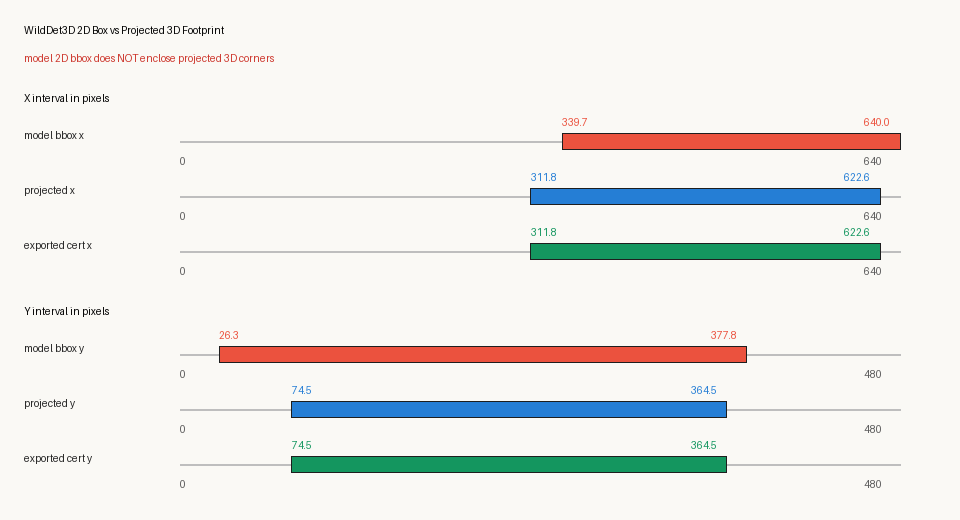
The accepted overlay uses the projected 3D footprint as the claimed box. The strict diagnostic overlay uses WildDet3D’s own 2D detection box. On the default example image, Lean rejects the strict claim because projected 3D corners fall outside that box.
What A JSON Artifact Looks Like
The concrete JSON is kept plain so the same checker can read artifacts from WildDet3D, Omni3D, or another detector/exporter that emits the camera and box fields.
{
  "format": "torchlean.camera.box3d.v1",
  "image_width": 640.0,
  "image_height": 480.0,
  "tol": 1.0,
  "camera_P": [1.0, 0.0, 320.0, 0.0, 0.0, 1.0, 240.0, 0.0, 0.0, 0.0, 1.0, 0.0],
  "corners3d": [0.0, 0.0, 8.0, 1.0, 0.0, 8.0, 1.0, 1.0, 8.0, 0.0, 1.0, 8.0,
                0.0, 0.0, 10.0, 1.0, 0.0, 10.0, 1.0, 1.0, 10.0, 0.0, 1.0, 10.0],
  "bbox2d": [319.0, 239.0, 321.0, 241.0]
}
For Cube R-CNN, Omni3D, or another detector, the export path is the same: export $K$ or $P$, image size, corners, and a claimed box, then run the Lean checker.
python3 scripts/verification/geometry3d/export_omni3d_box3d_cert.py \
  --prediction-json output/evaluation/predictions.json \
  --out _external/geometry3d/omni3d_box3d_cert.json \
  --verify
Negative Cases
Use the detector’s own 2D box to inspect a strict projection claim:
python3 scripts/verification/geometry3d/export_wilddet3d_box3d_cert.py \
  --text-prompt cat --bbox-source model2d \
  --out _external/geometry3d/wilddet3d/wilddet3d_cat_model2d_strict_box3d_cert.json \
  --overlay
The renderer runs the Lean checker and marks accepted and rejected artifacts. A model-box mismatch remains visible in this diagnostic; it is not repaired by changing the claimed box.
The Bug Zoo wrapper re-exports the theorem under a tutorial-facing name:
theorem accepted_camera_box_certificate_is_verified
    {cert : BoxCameraCert α}
    (h : checkCert cert = true) :
    Verified3DBox cert :=
  checkCert_sound h
There is also an interval robustness theorem for perspective division. If homogeneous projection numerator/depth intervals divide into a pixel interval contained in the bbox, every concrete camera choice represented by those intervals stays inside the same bbox. The displayed theorem keeps the readable shape of the statement; the full theorem includes the interval hypotheses.
theorem homogeneous_projection_uncertainty_stays_inside_bbox :
    xmin cert ≤ uNum / z ∧
      uNum / z ≤ xmax cert ∧
      ymin cert ≤ vNum / z ∧
      vNum / z ≤ ymax cert
Next, read the Bug Zoo walkthrough for the surrounding failure-mode catalog, or the Verification Bounds walkthrough for IBP and CROWN-style graph verification.